
What Are Some Common Terms Used in Orthopedics?
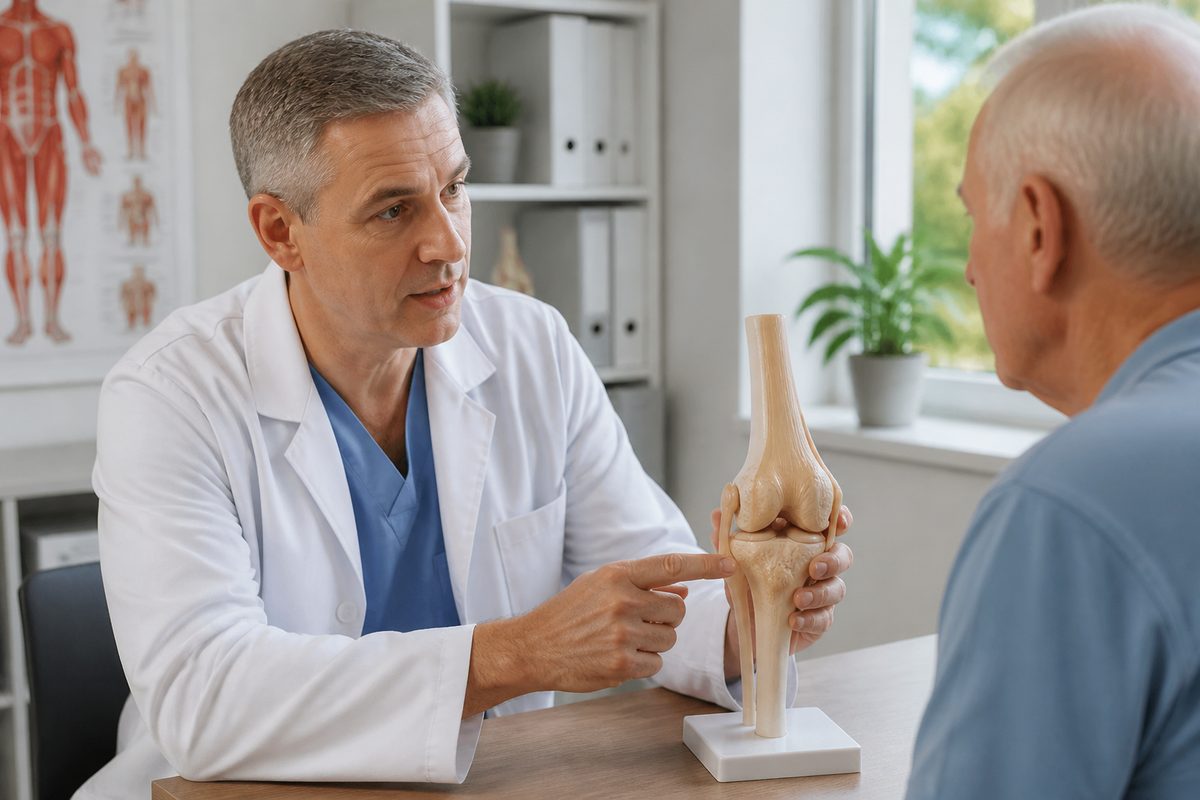
The most common orthopaedic terms fall into four groups: words for body position, words for bone and joint structure, names of injuries and conditions, and names of treatments. Learn those four groups and most of what your doctor says will make sense. This guide explains each group in plain language.
Orthopaedics is a medical specialty that focuses on the human musculoskeletal system. That system includes bones, joints, cartilage, ligaments, tendons and muscles. some common words used in surgery, so the words sound harder than the ideas behind them.
One of my clients, a runner in her fifties, left her first knee appointment with a page of notes and no idea what half of them meant. She told me she nodded along because she did not want to waste the doctor's time. That is common. A short glossary fixes it.
How do doctors describe where something hurts?
They use direction words. These words are fixed, so every surgeon, nurse and therapist means the same thing by them.
- Anterior: the front of the body.
- Posterior: the back of the body.
- Medial: toward the middle of the body.
- Lateral: toward the outside of the body.
- Proximal: closer to the trunk or the joint's attachment point.
- Distal: farther from the trunk.
- Superior and inferior: above and below.
So a note that says "medial knee pain" means pain on the inner side of the knee. A "distal radius" break is a break near the wrist end of the forearm bone. Once you know the pairs, you can decode most reports on your own.
Some other position words come up often. Flexion bends a joint and makes the angle smaller. Extension straightens it. Abduction moves a limb away from the body. Adduction moves it back in. Rotation is a twist around the joint's axis.
What do the main structure words mean?
A few structure words show up in nearly every visit.
A joint is where two bones meet. A ligament connects bone to bone. A tendon connects muscle to bone. People mix these two up all the time. A simple way to keep them straight: tendons move you, and ligaments hold you steady.
Cartilage is the smooth, slippery tissue that cushions joints. The main type at the ends of your bones is hyaline cartilage. It is glassy, smooth and has no blood supply, which is why it heals so slowly after damage. When someone says "the cartilage is worn," they usually mean this surface has thinned.
The meniscus is a different kind of cartilage. It is a C-shaped pad that sits between the thigh bone and the shin bone. Each knee has two. They act like shock absorbers and keep the joint stable.
A bursa is a small fluid sac that reduces friction. Synovium is the lining of the joint that makes lubricating fluid. Effusion means extra fluid in a joint, which is the swelling people call "water on the knee."
What words describe a broken bone?
A bone fracture is simply a break in a bone. Doctors add descriptive words to say what kind of break it is. These words guide treatment.
- Closed fracture: the skin stays intact.
- Open (compound) fracture: the bone breaks through the skin, which raises infection risk.
- Displaced fracture: the broken ends have moved out of line.
- Non-displaced fracture: the pieces still line up.
- Comminuted fracture: the bone breaks into several pieces.
- Stress fracture: a tiny crack from repeated load, common in runners.
- Greenstick fracture: a partial bend and crack, seen in children whose bones are still soft.
This matters because the label predicts the plan. A non-displaced wrist break often heals in a cast. A displaced or comminuted break often needs surgery. I know this because a friend's father fell on ice and heard "comminuted" in the emergency room. He assumed it meant the worst. It meant the bone was in several pieces, and that told the surgeon plates would be needed.
Two more words belong here. Union means the bone has healed. Nonunion means it has failed to heal after the expected time.
What do the common injury and condition names mean?
These are the names you will hear most often in a clinic.
Anterior cruciate ligament injury. The ACL is a ligament deep inside the knee. It keeps the shin bone from sliding forward. An anterior cruciate ligament injury is usually a sprain or tear that happens during a sudden pivot or stop. Players often describe a "pop" followed by swelling and a feeling that the knee gives way.
Meniscus tear. A meniscus tear is a rip in the knee's cushioning pad. It often comes from a twist while the foot is planted. It can also come from slow wear in older knees. Catching, locking and pain when you squat are typical signs.
Rotator cuff tear. The rotator cuff is a group of four tendons that hold the arm in the shoulder socket and lift it. A rotator cuff tear can be partial or full thickness. Pain at night and weakness when you lift your arm overhead are classic signs.
Carpal tunnel syndrome. The carpal tunnel is a narrow passage in the wrist. A nerve called the median nerve runs through it. When the space is squeezed, you get numbness, tingling and weak grip in the thumb, index and middle fingers. Night symptoms that wake you are the telltale sign.
Spinal stenosis. Stenosis means narrowing. In spinal stenosis, the space around the spinal cord or nerve roots gets tight. In the lower back, it often causes leg pain or heaviness while walking that eases when you sit or lean forward. A client of mine called it "shopping cart relief" because leaning on the cart made her legs feel better. That detail helped her doctor confirm the diagnosis.
Other words you may meet: osteoarthritis is wear-related joint damage. Tendinitis is an irritated tendon. Bursitis is an inflamed bursa. Sprain is a ligament injury. Strain is a muscle or tendon injury. People swap those last two, but the difference decides which tissue needs care.
What do surgery words mean?
Orthopaedic surgery has its own vocabulary. Many terms follow patterns, so a few suffixes unlock a lot.
- -ectomy: removal of a part. A meniscectomy removes damaged meniscus.
- -plasty: reshaping or repair. Arthroplasty reshapes or replaces a joint.
- -otomy: a cut into something. An osteotomy cuts a bone to realign it.
- -desis: binding or fusing together.
- -scopy: looking with a camera. Arthroscopy uses a thin scope through small cuts.
Now the big procedures.
Internal fixation. This means holding a broken bone in place with hardware inside the body, such as plates, screws, rods or pins. The hardware keeps the pieces lined up while the bone knits. External fixation does the same job with a frame outside the skin. Doctors pick it when swelling or skin damage makes internal hardware unsafe.
Spinal fusion. A spinal fusion joins two or more vertebrae into one solid piece of bone. Surgeons use bone graft and often screws and rods. The goal is to stop painful motion at a damaged level or to steady an unstable spine. Fusion is sometimes paired with a laminectomy, which removes part of the vertebra to give nerves room. That pairing is common in spinal stenosis surgery.
Hip replacement. Also called total hip arthroplasty, this surgery removes the damaged ball and socket of the hip and swaps them for implants. A partial or hemiarthroplasty replaces only the ball. Surgeons often use it after a hip fracture in older adults. Total joint replacement has a long track record of relieving pain when arthritis has worn the joint down.
Reconstruction versus repair. These two words get mixed up. Repair means stitching the original tissue back together, as with many rotator cuff tears. Reconstruction means building a new structure, usually from a graft. A torn ACL is typically reconstructed, because the ligament rarely heals by itself.
I remember when one of my clients was told he needed an "ACL reconstruction with a hamstring autograft." He thought the surgeon would use a donor. Autograft means tissue from your own body. Allograft means donor tissue. That one word changed how he felt about the operation.
What do rehab and recovery words mean?
Recovery has its own language, and it is the part that decides how well you do.
Physical therapy is supervised exercise and hands-on care that restores motion, strength and function. A physical therapist designs a program around your injury or surgery. The broader word therapy can also cover occupational therapy, which focuses on daily tasks like dressing and gripping, and other treatments aimed at easing pain or restoring movement.
Here are the terms you will hear in those sessions.
- Range of motion (ROM): how far a joint can move. Active ROM is you moving it. Passive ROM is someone else moving it.
- Weight-bearing: how much load you can put on a limb. Non-weight-bearing means none. Partial means some. Weight-bearing as tolerated means as much as feels okay.
- Immobilisation: holding a part still with a cast, brace or sling.
- Conservative treatment: care without surgery, such as rest, bracing, injections and therapy.
- Post-op: after surgery. Pre-op is before.
When I tried to explain weight-bearing to a client after her ankle fracture, she had thought "partial" meant "whatever feels fine." It does not. Partial often means a set number of pounds. Putting too much on the leg too soon can move the hardware or slow healing. Always ask for the exact number.
What words describe tests and imaging?
You will hear a few test names early in the process.
An X-ray shows bone well. It shows fractures and arthritis changes. An MRI shows soft tissue like ligaments, tendons, cartilage and the meniscus. A CT scan gives detailed bone images and helps plan complex fracture surgery. Ultrasound can show tendons and fluid in real time. An EMG tests nerve and muscle signals, which helps confirm carpal tunnel syndrome.
A diagnosis is the name of the problem. A prognosis is the expected outcome. An indication is the reason a treatment is recommended. A contraindication is a reason not to use it. Knowing these four words lets you ask sharp questions.
What is the best way to use these terms at an appointment?
Treat the glossary as a question tool. When a word comes up that you do not know, stop and ask for it in plain language. Doctors expect this. Most are glad to slow down.
What I found works is to write down three words from each visit and look them up that night. Then bring your answers to the next appointment. You will notice the conversation gets faster and more useful because you stop spending time decoding.
Also ask for the spelling of any diagnosis. It makes searching reliable and keeps you from mixing up similar-sounding words, like arthroscopy and arthroplasty. One means looking inside a joint. The other means rebuilding it. That difference is huge.
What should you do next?
- Learn the direction pairs. Anterior, posterior, medial and lateral will decode most reports.
- Write down your exact diagnosis. Ask which tissue is affected, whether it is a sprain or a strain, and whether the injury is partial or complete.
- Ask what each treatment term means. If you hear fixation, fusion or replacement, ask what is placed in your body and why.
- Get exact rehab rules. Ask for weight-bearing limits and range of motion goals in numbers and dates.
- Bring this list to your next visit. Circle the words you hear, and ask about any that are missing.
Start today with one step: pull up your last visit summary and circle every word you cannot define. Look up each one, and you will walk into your next appointment ready to take part in the decision.