
What Can You Never Do Again After Knee Surgery?
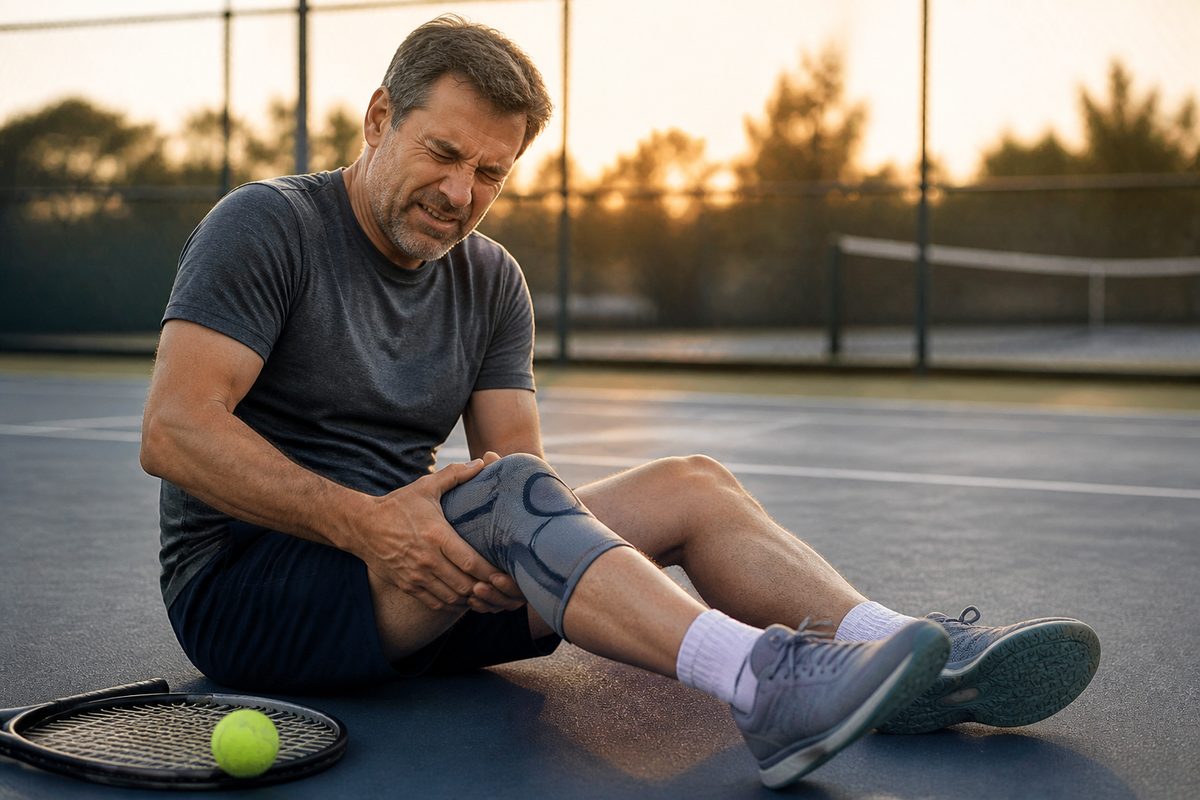
Very little is banned for good after knee surgery, but high-impact activities are the ones surgeons most often tell you to give up. Running, jumping and hard-cutting sports sit at the top of that list after a knee replacement. Walking, cycling, swimming and most daily tasks come back.
The advice is a pattern, not a fixed rulebook. A review of 23 studies found that clinicians generally steer people toward low-to-moderate impact activity and away from high-impact sport, mostly out of concern for how long the implant lasts. Most of those studies were low or moderate quality, so the advice reflects careful professional opinion more than firm proof of harm.
Which activities do surgeons most often rule out?
The activities that draw the most warnings share one trait: they hit the joint hard or twist it under load. After a knee replacement, that usually means:
- Running on hard ground, especially long distances
- Jumping sports such as basketball and volleyball
- Any contact sport, including football, rugby and martial arts with takedowns
- Sports that need fast pivots, such as squash, tennis singles and skiing on steep runs
Notice what is missing. Nobody bans stairs, gardening, golf, hiking or dancing outright. Those sit in the low-to-moderate range where most people are directed.
A contact sport is the clearest case. A fall or a collision can crack bone around the implant or damage the parts. That risk is real even if your knee feels strong.
Why does high impact worry surgeons so much?
A knee implant is metal and plastic. It does not heal or rebuild itself the way bone does. Every step wears it a little. Hard landings and repeated pounding can speed that wear up.
Twisting adds a second problem. Shear stress is a sideways force that slides one part of the joint across another. Pivoting on a planted foot creates a lot of it. Implants handle straight-line loading better than they handle repeated shear. That is why a brisk walk is easy on a new knee and a hard turn in a pickup game is not.
Surgeons also think about time. A 55-year-old with a new knee may need that implant for 25 years or more. Each year of heavy use spends some of that supply. This concern for implant life shaped the recommendations in the review.
Here is the angle most articles miss. The fear is about wear and survival of the implant, not about your knee suddenly breaking the first time you jog. Surgeons are managing odds over decades. That is why the advice leans cautious even though the proof is thin.
Which restrictions are only temporary?
Most of what you lose in the first months comes back. Early limits protect healing tissue and the new joint while swelling goes down and strength returns.
Expect these to be short-term:
- Driving, until you can brake hard without pain and are off strong pain medicine
- Kneeling, which feels awkward or sore for a long time but is not harmful to most people
- Stairs without a rail
- Long walks and standing shifts
- Swimming, until the wound is fully closed
Imagine a client who tells you in week three that she is sure she will never garden again. By month four, with steady physical therapy, she is back on her knees on a foam pad, pulling weeds. The early fear came from stiffness and swelling, not from a permanent limit. That pattern is common.
Physical therapy is what turns a temporary limit into a finished one. Skip it and you can end up with a stiff knee that stays stiff. Do it well and you recover the function you need for most activities.
How much does range of motion matter?
Range of motion is how far you can bend and straighten the knee. It decides more of your daily life than any banned-sport list. You need about 90 degrees of bend to climb stairs comfortably and a bit more to rise from a low chair or get into a car with ease.
Scar tissue can lock the knee if you rest too much early on. Straightening fully matters just as much as bending. A knee that will not straighten makes walking tiring.
This is the practical reason to treat therapy as part of the surgery. The operation fixes the joint surface. Your work afterward builds the motion and strength that let it do its job. Plan on daily exercises at home, not only clinic visits.
Does the type of knee surgery change the answer?
Yes. The research behind the cautious advice looks at total knee replacement. Other knee operations carry different rules. A single label of knee surgery covers a lot of ground, as the broader overview of orthopedic surgery types shows.
Partial and total knee replacement
A partial replacement swaps only one damaged section. Many surgeons allow a somewhat broader return to activity afterward, but only your surgeon can say how far that goes for you. A total replacement follows the cautious pattern above.
Anterior cruciate ligament reconstruction
Anterior cruciate ligament reconstruction is a different problem. The goal there is a stable knee for sport, so many people return to pivoting and cutting activity. The limits come in the early months, while the graft heals and strengthens. Do not apply knee replacement rules to this surgery or the other way around.
Arthroscopy and minimally invasive surgeries
Minimally invasive surgeries use smaller cuts and often mean a faster start to recovery. They do not change what the repaired or replaced joint can handle long term. A small scar does not make an implant tougher. Follow the rules for the procedure, not the size of the incision.
Do you need antibiotics before dental work?
This is a rule people rarely hear until later. Bacteria from the mouth can travel through the blood and, rarely, settle around an implant. Some surgeons ask patients to take antibiotic prophylaxis before certain dental procedures, at least for a period after surgery. Others do not. Practice varies, and I will not guess which applies to you.
Do this instead. Ask your surgeon one direct question: should I take antibiotics before dental work, and for how long? Then tell your dentist the answer and the date of your surgery.
One more note on teeth. A dental implant is a separate matter from your knee implant, and having one does not stop you from having a knee replacement or the reverse. Mention both to each provider, so everyone knows what is in your body.
How do you set your own limits?
Treat the question as a personal conversation, not a lifelong rule. That is my reading of the evidence, not a study result. The review points to caution, and it also shows that individual circumstances shaped the advice. Your limits depend on four things:
- The type of surgery you had
- Your age
- Your fitness before surgery
- Your activity history, including the sports you already did well
That last point matters more than most people expect. A person who played tennis for 30 years and has strong legs is in a different spot than someone who wants to start running at 68. Experience and muscle control protect a joint. Starting a new high-impact sport after replacement is the riskier move.
Picture a client who loved doubles tennis before his operation. He asks if he is done with the sport. The honest answer is probably not done, but changed. He may play doubles on a softer court, avoid lunging for wide shots and stop when his legs tire. That is a modified return, not a ban. Many surgeons approve a plan like that, though some will not. Ask yours.
What are the warning signs that you pushed too hard?
Your knee will tell you before the implant fails. Watch for:
- Swelling that comes back after activity and does not settle overnight
- Pain that grows over weeks rather than easing
- A feeling that the knee gives way or shifts
- New clicking with pain
- Warmth, redness or fever, which needs urgent care
Mild soreness after a new activity is normal. Pain that lasts into the next day is a signal to back off and call your care team.
What should you do next?
Do not hunt for a master list of forbidden activities. It does not exist. Use this plan instead:
- Ask your surgeon which activities you want to keep and which they advise against, and ask why for each one.
- Do your physical therapy exercises daily until you regain full straightening and a strong bend.
- Choose low-to-moderate impact activity first, such as walking, cycling and swimming.
- Ask about antibiotic prophylaxis before dental work and tell your dentist about your implant.
- Add any demanding activity only after your surgeon or physiotherapist agrees, and add it slowly.
If you take one step today, write down the three activities you care about most and bring that list to your next appointment. A clear answer for your knee beats any general rule.
Sources
- Goheen C, Goetti T, Trapeau J, Parikh P, Van Bussel J, Gillis H, et al. (2026) "Return to Sport Guidelines Following Total Knee Arthroplasty: A Scoping Review" Physiotherapy Canada. Physiotherapie Canada. PMID: 42840866
- Hanreich C, Martelanz L, Koller U, Windhager R, Waldstein W (2020) "Sport and Physical Activity Following Primary Total Knee Arthroplasty: A Systematic Review and Meta-Analysis" The Journal of Arthroplasty. DOI: 10.1016/j.arth.2020.04.013