
What Does the Term "Orthopaedic" Mean?
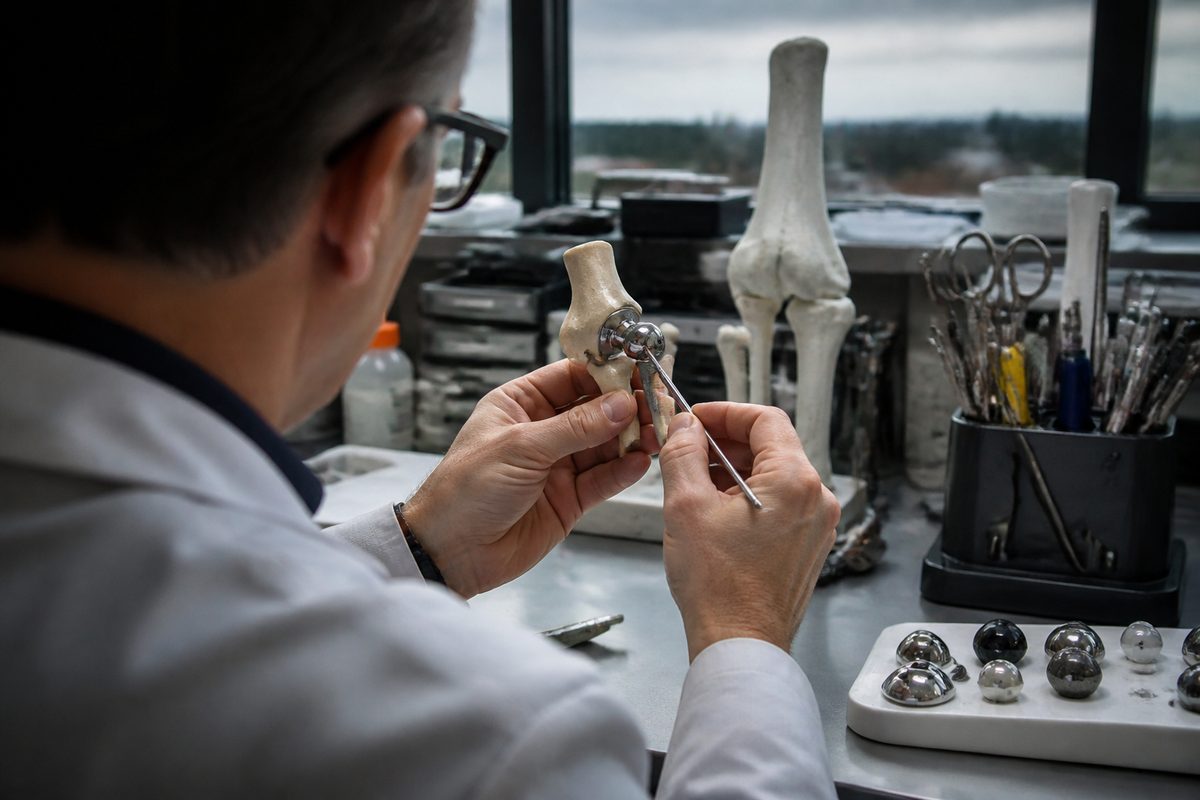
"Orthopaedic" means relating to the correction and care of the bones, joints, muscles and other moving parts of the body. The word comes from two Greek roots: orthos, meaning straight, and paideia, meaning the rearing of a child. So the literal meaning is "straight child." The word has outgrown that meaning, but the idea of fixing what is bent or broken still sits at its core.
This article looks at the word itself. Where did it come from, why does it sound so odd for a field that treats adults, and what are you actually being told when someone says it? Knowing this helps you read referral letters, book the right appointment and avoid a few common mix-ups.
Where did the word come from?
A French physician named Nicolas Andry coined the term in 1741. He wrote a book called Orthopaedia. Its full title promised to teach parents how to prevent and correct deformities in children. Andry was not a surgeon in the modern sense. He was a doctor who believed that posture, exercise and simple braces could straighten a growing body.
He also chose a symbol that is still used today. Andry drew a young tree tied to a straight wooden stake. The tree bends. The stake guides it upright over time. Many orthopaedic societies still put that crooked tree on their logos.
I find this useful when explaining the word to people. The founding image is not a scalpel. It is a slow, patient guide for something that is growing. That is a very different picture from the one most people carry into the clinic.
Why does a word about children cover adults now?
The field changed faster than the name did. In Andry's time, bone problems were mostly seen in children. Think of clubfoot, curved spines and bowed legs. Doctors treated them with splints and stretching.
Over the next two centuries, anaesthesia, X-rays and sterile surgery arrived. Doctors could now repair breaks, replace worn joints and treat injuries from factories, railways and war. The patient group grew to include every age. The word stayed because it was already on the hospital doors and the textbooks.
Today the "straight child" meaning is history. A better working definition is this: orthopaedics is the branch of medicine that deals with the structure and function of the body's frame and its moving parts, from birth to old age.
What body parts does the word point to?
When a clinic calls itself orthopaedic, it is telling you it deals with the human musculoskeletal system. That system holds the body up and lets it move. It includes bones, joints, cartilage, ligaments, tendons and muscles. It also includes the connective tissue that ties these parts together.
Here is how the parts divide up:
- Bones give shape and protect organs.
- Joints let bones move against each other.
- Cartilage cushions the joint surfaces.
- Ligaments hold bone to bone.
- Tendons attach muscle to bone.
- Muscles create the force that moves everything.
Notice what is missing. Orthopaedics does not cover the brain, the nerves as a primary focus, or the organs. A pinched nerve in the neck often lands with an orthopaedic spine specialist because the cause is a bone or disc problem. A stroke does not, because the cause is in the brain.
Is orthopaedic a surgical word or a general one?
This is where most people get confused, and where many articles get it wrong. "Orthopaedic" is a broad word. It describes a medical specialty, and that specialty includes surgeons and non-surgeons.
One of my clients told me she avoided an orthopaedic clinic for a year with knee pain. She assumed they would book her for an operation on the first visit. what happens when you go to an orthopedic doctor, the doctor sent her to exercise-based care and gave her an injection. No surgery was discussed. She told me later, "I wish someone had said the word does not mean operating room."
She is right. Most orthopaedic visits end without surgery. Doctors in this field try bracing, medication, injections and rehabilitation first. Surgery is one tool among many, and it is usually the later one.
That said, orthopaedic surgery is the best-known branch. Surgeons in this branch repair, rebuild or replace damaged parts of the musculoskeletal system. The word "orthopaedic" on its own is wider than that. It also covers the doctors, nurses and therapists who care for the same patients without operating.
What are the main areas inside the field?
Knowing the sub-areas tells you what a given doctor does day to day. The word is a heading. Under it sit several distinct kinds of work.
Trauma and fracture care
Trauma surgery deals with sudden, serious injuries such as broken thigh bones, crushed pelvises and fractures from car crashes. Many trauma cases rely on internal fixation. That means using metal plates, screws, rods or pins placed inside the body to hold broken bone in the right position while it heals. A simple cast is external. Internal fixation sits under the skin and stays put.
Joint replacement
Joint replacement removes a worn joint surface and replaces it with a metal, plastic or ceramic implant. Hips and knees are the most common. People usually reach this point after years of arthritis that no longer responds to other care. In my experience, the people who do best are the ones who start strengthening exercises well before the operation.
Sports and overuse problems
A sports injury is damage that happens during exercise or competition. Torn knee ligaments, rotator cuff tears and stress fractures are typical. Orthopaedic sports medicine covers both elite athletes and weekend runners. I know this because a client of mine, a recreational footballer in his forties, assumed his "sports" injury meant he needed a sports clinic. He was right. The orthopaedic doctor who treated him was a sports specialist who handled his ligament tear and set his return timeline.
Spine, hand, foot and pediatric care
Some doctors narrow down further. Spine surgeons focus on the back and neck. Hand surgeons treat fingers, wrists and the small bones and tendons that make fine movement possible. Foot and ankle specialists manage bunions, flat feet and ankle fractures. Paediatric orthopaedists treat growing bodies, which brings the field back to where Andry began.
Who else works under the orthopaedic label?
The doctor is only one person on the team. Two other roles matter a great deal.
Orthopaedic nursing is a nursing specialty built around patients with bone, joint and muscle problems. These nurses care for people before and after surgery. They watch for swelling, check circulation in a casted limb, manage pain and teach patients how to move safely. When I had a family member go through a hip repair, the orthopaedic nurse caught a circulation problem in the foot hours before anyone else noticed it. That kind of close watching is the point of the specialty.
Physical therapy is the hands-on, exercise-based treatment that helps people regain strength and movement. Therapists are not orthopaedic doctors, but their work is closely tied to orthopaedic care. Almost every joint replacement and fracture repair depends on it. A perfect operation with poor rehabilitation still gives a poor result.
How is orthopaedics different from rehabilitation medicine?
People often mix these up, and the confusion costs them time. Physical medicine and rehabilitation, sometimes called PM&R or physiatry, is a separate medical specialty. Its doctors focus on function. They ask how a person can move, work and live with the least pain and the most ability. They treat conditions like back pain, nerve injuries, stroke recovery and amputations, and they mostly do not perform major surgery.
Orthopaedics asks, "What is structurally wrong, and can we fix it?" Rehabilitation medicine asks, "How do we get this person functioning well?" The two overlap on conditions like chronic back pain and sports recovery. Good orthopaedic clinics often work side by side with rehabilitation doctors.
A practical rule: if you suspect a structural problem such as a torn ligament, a fracture or a worn joint, start with orthopaedics. If your main issue is ongoing pain, weakness or reduced function without a clear structural cause, rehabilitation medicine may be the better first stop.
Why are there two spellings?
You have seen both "orthopaedic" and "orthopedic." Both are correct. This is one of the clearest cases of American and British English spelling differences.
The original Greek-based spelling kept the "ae" pair, which came from the Latin and Greek letter combination. British English held onto it. American English simplified many such words, the same way "paediatric" became "pediatric" and "anaesthesia" became "anesthesia." So the split looks like this:
- Orthopaedic is standard in the UK, Australia, New Zealand and much of the Commonwealth.
- Orthopedic is standard in the United States and Canada.
The meaning is identical. Some American institutions still use the older spelling in their formal names. The American Academy of Orthopaedic Surgeons is one of them. So seeing the "ae" spelling does not mean a clinic is British. It may be a deliberate nod to tradition.
One more point that most guides skip. The spelling also appears on products. "Orthopaedic mattress," "orthopaedic shoes" and "orthopaedic pillow" are common retail terms. These are marketing words. They suggest the product supports the body's frame, but the label alone does not mean a doctor approved it. If you have a real medical condition, a clinical assessment matters more than a product name.
What does it mean when a doctor says it to you?
The word shows up in three common situations, and each one means something specific.
First, a referral. If your family doctor writes "orthopaedic referral," they believe your problem sits in a bone, joint or related structure and needs a specialist opinion. It does not mean you need surgery. It means you need an expert to look at the structure.
Second, a diagnosis. Terms like "orthopaedic injury" or "orthopaedic condition" simply say the problem belongs to the musculoskeletal system.
Third, an aid or device. An "orthopaedic brace," "orthopaedic boot" or "orthopaedic insole" is a support designed to hold, protect or realign a body part. These are prescribed or fitted to reduce strain while the body heals or to ease a long-term problem.
What do most people get wrong about the word?
Three misunderstandings come up again and again with the people I talk to, and each one delays good care.
The first is that orthopaedic means surgery only. It does not. Most of the field is conservative care.
The second is that it is for old people or athletes only. Children with growth problems, office workers with wrist pain and new parents with back strain all fit.
The third is that it covers all pain. Headaches, nerve disease and organ pain sit elsewhere. If your pain starts in a moving part of the body and gets worse with movement, orthopaedics is likely the right fit. If it comes with fever, numbness across a wide area or loss of bladder control, you need urgent medical care first.
How do you use this to choose the right care?
Once you know what the word covers, you can match your problem to the right door. Here is a simple way to do it.
- Name the body part and the movement that hurts. "My right knee hurts going downstairs" gives a doctor far more than "my leg hurts."
- Decide whether the problem started suddenly or built up slowly. Sudden injuries often need trauma or sports care. Slow ones often fit joint or spine care.
- Ask your family doctor whether an orthopaedic referral makes sense, or whether rehabilitation medicine or physical therapy should come first.
- Ask the specialist what non-surgical options exist before you discuss surgery.
- Ask who handles your rehabilitation afterward, so your recovery plan is clear from day one.
One of my clients followed this exact order with a nagging shoulder problem. She walked into her appointment with the movement that hurt, the date it began and two questions about non-surgical options. The visit took half the time she expected, and she left with a rehab plan rather than a surgical date.
The one thing to do next
Next time you see the word orthopaedic, read it as "the part of medicine that looks after your body's frame and how it moves." Then write down which joint, bone or muscle is bothering you, how it started, and what movement makes it worse. Take that note to your family doctor and ask if an orthopaedic assessment is the right next step. That single page will get you to the right care faster than any search.