
What Is the Etymology of the Word "Orthopedic"?
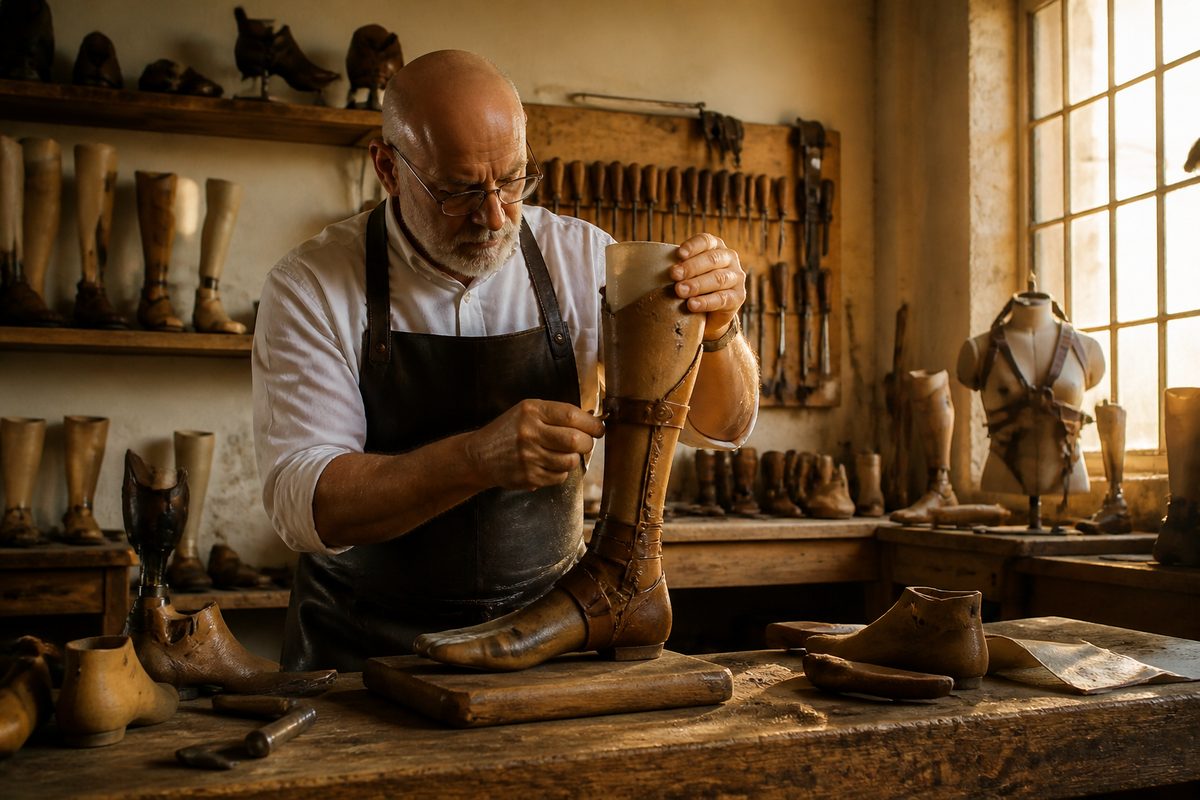
"Orthopedic" comes from two Ancient Greek roots, orthos ("straight" or "correct") and pais ("child"), joined into one word by the French physician Nicolas Andry in 1741. Literally, it means "straight child." Andry meant the raising of children with straight, healthy bodies. Today the word covers bones, joints and muscles at every age, which is why its roots surprise most people.
The history is short, and every step in it is easy to follow. Once you know it, the word stops being a label you memorise and becomes one you can read.
Who made up the word, and why does it come from French?
Nicolas Andry de Bois-Regard was a Medical doctor in Paris. He taught at the university and later led its faculty of medicine. In 1741, at an age when most people have retired, he published a book with a very long title. In English it reads: "Orthopaedia, or the Art of Preventing and Correcting Deformities of the Body in Children."
The original was written in the French language, as L'orthopédie. That detail matters. Andry did not find the word in an old Greek text. He built it, the way scientists still build new terms from Greek parts. French was the language of European medicine at the time, so the new word spread through French first and then into English, German and the rest.
I know how this works from the other side. When I explain the word to people, many assume it is ancient. It is not. "Orthopedic" is younger than the United States Constitution. Andry coined it, and the field grew around his word.
What do the Greek roots actually mean?
Break it into two parts.
- Ortho- comes from orthos. It means straight, upright or correct. You see it in "orthodontist" (straight teeth) and "orthodox" (correct belief).
- -pedic comes from the Greek word for child. It has nothing to do with feet.
That last point trips people up. Feet are "ped-" in Latin, as in pedal, pedestrian and podiatry's cousin "pedicure." The Greek child-root looks almost the same in English, so the two get mixed up. Andry's word is about raising a child, not about legs or feet.
The second root has a fuller form. Ancient Greek used paideia for the rearing and education of a child. Andry reached for that idea because his goal was guidance. He wanted parents to shape a child's growth so the body stayed straight.
Why does the Greek word for child look so different inside "orthopedic"?
Here is the part most articles skip. The Greek noun for child is pais. Yet the word we use has "paed" in it, not "pais." The reason is the genitive case.
Ancient Greek changed the endings of nouns to show their job in a sentence. The genitive case marks possession or relation, like "of the child." For pais, the genitive form is paidos. The stem is paid-. That stem, not the base form, feeds paideia and later the English "paed-" and "ped-" in words like pediatric, pedagogy and orthopedic.
One of my clients, a retired teacher, noticed this on her own. She asked why "pediatric" and "pedagogue" share a start with "orthopedic." The answer is that all three come from the stem of one Greek noun. A pedagogue was once a person who led a child. A pediatrician treats the child. An orthopedist, in Andry's sense, straightens the child. Same root, different job.
Why do some people spell it "orthopaedic"?
The longer spelling keeps the original Greek diphthong, "ai," which Latin writers wrote as "ae." British English kept it. American English dropped the extra letter, the same way it turned "paediatric" into "pediatric" and "anaesthesia" into "anesthesia."
Both spellings mean exactly the same thing. The older form survives in some official names. The American Academy of Orthopaedic Surgeons, founded in 1933, still uses the "ae" spelling in its title, even though it sits in the United States. Many hospitals and journals do the same to honour the root. So if you see both spellings on one page, nobody made a mistake.
When I tried searching for the field using only the short spelling, I missed some textbooks. If you are doing research, search both.
What was the crooked tree on Andry's cover?
Andry's book carried a drawing of a young tree bent to one side and tied to a straight wooden stake. The image made his point at a glance. A bent young tree can be guided into a straight one if you support it early. He believed a child's body worked the same way.
That picture became the symbol of the field. Orthopedic societies around the world still use versions of the tree and stake. The American Academy of Orthopaedic Surgeons has used that kind of imagery as well. It is a rare case where the logo explains the word's origin better than a dictionary can.
The image also shows how Andry thought. He did not picture surgery. He pictured gentle, steady correction. Braces, exercises and posture were his tools. Cutting was not part of the plan.
How did a word about children end up covering adults?
The meaning stretched over about two centuries. The change came from what the doctors in the field actually did.
In the early years, practitioners worked on clubfoot, curved spines and bowed legs in children. They built braces and special beds. Orthopedic institutes opened in Europe to treat young patients. Then three things pulled the field toward adults.
- Wars and factory work produced injuries that needed repair, and the same doctors who straightened bones in children were the best placed to help.
- Anaesthesia and clean surgical technique made operating safer.
- X-rays, which arrived in 1895, let doctors see inside a limb for the first time.
A bone fracture in an adult is a different problem from a bent spine in a child, but the logic of straightening carried over. A broken bone has to be set back into line to heal well. The Greek idea of "straight" still fit, even though "child" no longer did.
In the twentieth century, internal fixation changed the daily work. Surgeons began holding broken bones in place from the inside with plates, screws and rods. That moved the field far from Andry's braces and stakes. Yet the aim is the same: put the bone in its correct line and keep it there. The tree on the old book cover is, in a sense, an early form of internal fixation made of wood and rope.
I saw how far the word had traveled when a client broke her wrist at age 68. Her surgeon used a plate and screws. She laughed when I told her the word on her discharge papers once meant "straight child." She was not a child, and she was not being raised. She was being put back in line.
What does "orthopedic" cover today?
Modern orthopedics is a medical specialty that deals with the human musculoskeletal system: bones, joints, ligaments, tendons and muscles. Its patients range from newborns with hip problems to older adults with worn knees.
Orthopedic surgery is one branch of that work, and not the only one. Many orthopedic doctors treat patients with casts, braces, injections and rehabilitation plans, and never operate. Andry would probably recognise that side of the field best, since his own methods were non-surgical.
The word kept its shape while its meaning grew. That happens often in language. Nobody calls a telephone "far sound" anymore, though that is what the Greek parts mean. "Orthopedic" works the same way. The roots describe where the idea began, not the full job today.
What does the etymology teach you when you read medical terms?
Most medical words are built from a few Greek parts, and the orthopedic example shows the method. You can read an unfamiliar word by cutting it into pieces.
Here is how I use it. Take "orthotic." It starts with the same orthos, so it relates to straightening or correcting. An orthotic is a device that supports or corrects the body, such as a shoe insert. Now take "orthodontic." Same start, plus the Greek root for tooth. Straight teeth. Once you know ortho-, you can guess the meaning of a dozen words without a dictionary.
There is also a trap to avoid. Do not assume that a word's original meaning still describes current practice. If you decide that orthopedics is only for kids because of the Greek, you will miss the right doctor for your own knee. Likewise, if you assume "orthopedic" always means an operation, you may delay a simple visit. The word's history explains the name. It does not set the limits.
Your next steps
Use what you now know in three ways. Wait, that is a list of three, so here are two clear actions instead.
- Read medical words in pieces. The next time you meet a term that starts with ortho-, pause and think "straight or correct." Then look at the ending to find the body part or action. You will often get the meaning right on the first try.
- Match the word to the need, not to its origin. If you or a family member has a bone, joint or muscle problem at any age, an orthopedic doctor is the right place to start. Search both "orthopedic" and "orthopaedic" when you look for clinics, journals or guidelines, so you do not miss good sources.
The takeaway is simple. "Orthopedic" began as a French coinage for straightening children, and it grew into the name for care of the whole musculoskeletal system. Learn the roots once, and you can read the rest of the vocabulary with confidence.