
What Does the Term "Orthopaedic" Refer To?
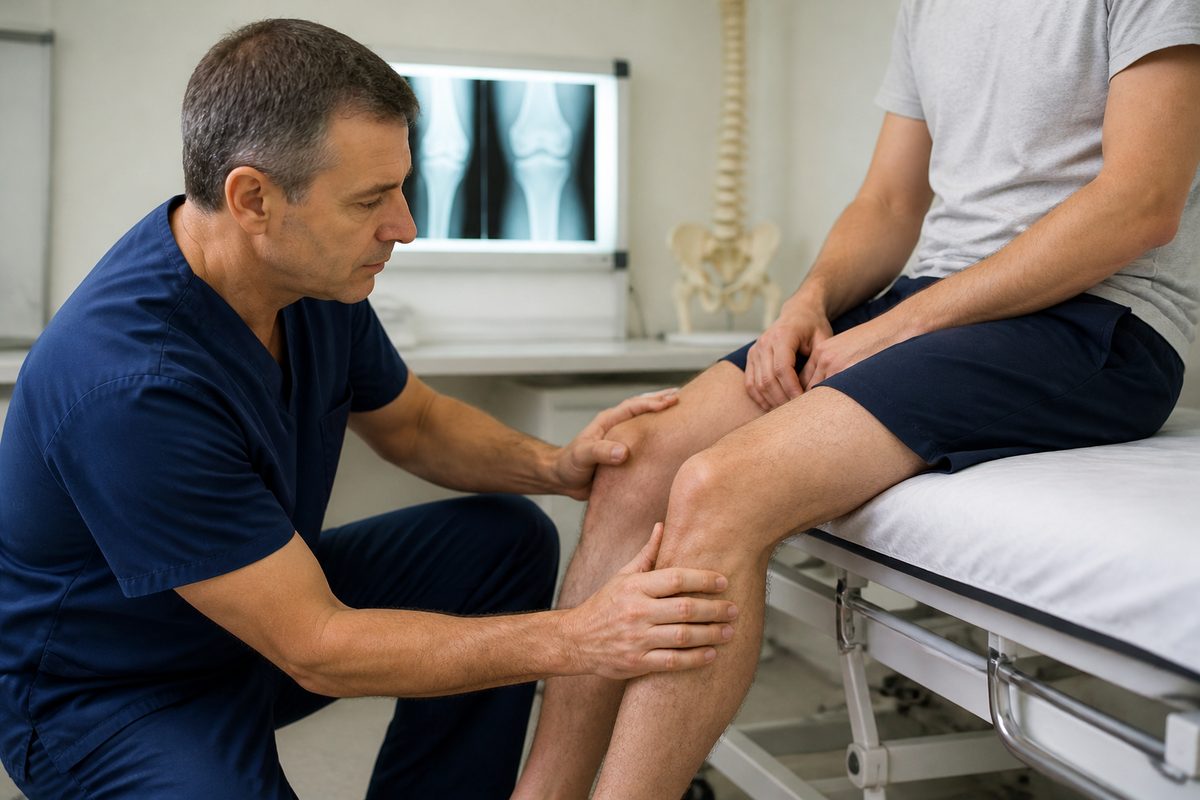
"Orthopaedic" refers to anything related to the bones, joints, muscles, ligaments and tendons that hold your body up and let it move. It names a body system and the branch of medicine that cares for it. When you see the word on a clinic sign, a referral letter or a scan report, it points you to the frame of the body and its moving parts.
That is the full definition. Most of what follows is about what the word means in real life: where you meet it, what it signals and how to use it to get to the right help faster.
Which body system does the word point to?
It points to the human musculoskeletal system. This is the set of structures that gives you shape, protects your organs and turns a decision to walk into a step.
- Bones are the rigid frame.
- Joints are the hinges and sockets where bones meet.
- Muscles and tendons pull on the bones to create movement.
- Ligaments tie bone to bone and keep joints stable.
common terms used in orthopedics, so the word often reaches into those too. A pinched nerve in the neck or a shattered heel bone both land in the same territory because the damage sits in the structure of the body.
The word does not cover the brain, the heart or the digestive tract. If the problem is inside an organ, you want a different specialist. If the problem is in the frame or the moving parts, "orthopaedic" is the right label.
Where did the word come from, and why does it matter now?
It comes from two Greek roots. One means straight. The other means child. The word was coined in 1741 by Nicolas Andry, a French physician who wrote a book on preventing and fixing bent bodies in children. He drew a crooked young tree tied to a straight stake on the cover. That image still shows up as the symbol of many orthopaedic groups.
The history matters for one reason. It shows the word started as a promise to straighten. Today the work is wider. It covers a toddler with a twisted foot, a teenager with a torn knee ligament and a retired teacher with worn hips. The root meaning of "straight" has stretched to mean "working as it should."
A lot of articles dwell on the story of the tree. I think the more useful point is this: the word is about function. A modern orthopaedic team measures success by whether you can climb stairs, lift a grandchild or sleep without pain. Straightness is only one way to get there.
Is the word a label for surgeons only?
No. This is the most common mix-up I see. People hear "orthopaedic" and picture an operating room. In practice, most visits never reach one.
Orthopaedic surgery is one branch. It is the part where a surgeon repairs, rebuilds or replaces something. The wider field includes exams, imaging, braces, injections, exercise plans and long-term monitoring. Many orthopaedic surgeons spend more of their week in clinic than in theatre, and they often steer patients away from surgery when other care will do.
One of my clients, a woman in her fifties with an aching shoulder, booked an orthopaedic appointment convinced she needed an operation. The surgeon examined her, ordered an image, and sent her to a physical therapist instead. Eight weeks of targeted exercise later, the pain was gone. She had assumed the word meant "surgery." It meant "the right specialist to decide."
So read the word as a doorway. Behind it, the first question is always whether you need surgery at all.
What kinds of problems fall under the term?
Three broad groups of problems sit behind the word, and knowing which one you have makes the visit smoother.
Sudden injuries
A fall, a car crash or a twist on the court can break a bone or tear a ligament. Fractures are the classic case. A sports injury such as an ACL tear, a dislocated shoulder or a torn Achilles tendon also belongs here. The pain starts at a clear moment, and you usually know what caused it.
Wear and age-related change
Some problems build slowly. Osteoarthritis is the best known example. A degenerative disease of this kind wears down the smooth cartilage that lets joints glide. Discs in the spine can also thin and bulge over the years. Pain creeps in, stiffness grows in the morning and you start to avoid stairs without admitting why.
Conditions present from birth or childhood
Clubfoot, hip problems in infants and curved spines in teenagers are the problems the word was first made for. They are still a core part of the field.
If your trouble fits one of these groups, the term applies to you. If it does not, such as chest pain or a skin rash, the word is the wrong signpost.
How does the field split into specialties?
Once you walk through the door, you may find the work is divided by body region or by patient type. This is useful to know because a general orthopaedic clinic may refer you onward.
- Hand and wrist surgeons treat fractures, nerve compression and tendon injuries in the fingers and forearm.
- Spine specialists handle disc problems, narrowed canals and curves.
- Foot and ankle specialists manage everything from bunions to complex breaks.
- Paediatric orthopaedics focuses on growing bodies.
Sports medicine deserves its own mention. It is a branch built around active people, from weekend runners to professional athletes. Some sports medicine doctors are orthopaedic surgeons. Others are trained in primary care and treat injuries without operating. Both groups care about getting you back to play safely, and both fall under the broad meaning of the term.
What do orthopaedic doctors actually do for you?
The work follows a ladder. Doctors start with the simplest option that can work and climb only when needed.
First comes the exam. The doctor watches you walk, tests how far a joint bends and presses on sore spots. Then comes imaging. A plain X-ray shows bone well. A CT scan builds a detailed three-dimensional picture of bone and is useful for complex fractures. Magnetic resonance imaging, often called MRI, shows soft tissue such as cartilage, ligaments and discs. Each test answers a different question, so a doctor may order one and skip the others.
Next comes non-surgical care. This includes rest, bracing, anti-inflammatory medicine, injections and physical therapy. Physical therapy is the workhorse of the field. It strengthens the muscles around a damaged joint so the joint carries less load. In my experience, people underrate it until they try it and feel the difference.
Surgery comes last, and it takes several forms:
- Internal fixation uses plates, screws or rods to hold a broken bone in position while it heals.
- Joint replacement swaps a worn hip or knee for a metal and plastic implant.
- Spinal fusion joins two or more vertebrae into one solid piece to stop painful motion between them.
- Arthroscopy uses a tiny camera and small tools to repair a joint through keyhole cuts.
I know this because a client of mine, a 68-year-old with a failing knee, went through the whole ladder. He tried bracing, then injections, then a year of exercise. When none of it held, he had a knee replaced. He told me the surgery was the easy part because the earlier steps had shown him it was the right call.
Why are there two spellings?
"Orthopaedic" and "orthopedic" mean the same thing. The extra "a" comes from the Greek root for child, and it survives in British, Australian and many international texts. American writing dropped it. Neither is wrong.
The spelling does matter in one practical way. When you search online for a clinic, try both. Some practices use one form in their name and the other in their page text. Searching only one can hide good results.
How is the word different from similar terms?
People mix up three words that sit close together, so here is how they differ.
Rheumatology deals with autoimmune and inflammatory joint disease such as rheumatoid arthritis. These doctors mostly use medicine, not surgery. A swollen, stiff hand in several joints at once often points here first.
Podiatry focuses on the foot and ankle. Some of its work overlaps with orthopaedics, but the training path is different.
Chiropractic care uses hands-on spinal and joint adjustment. It is a separate profession and does not involve surgery or prescribing in most places.
If you are unsure, the orthopaedic label is the safest starting point for a structural problem. A good clinic will tell you quickly if you belong somewhere else.
What does it mean when a doctor says the word to you?
Context decides it. If a family doctor says "I am sending you to orthopaedics," they suspect a problem in a bone, joint or soft tissue that needs a specialist's eyes. It does not mean they think you need surgery. If a radiologist writes "orthopaedic hardware" on a report, they mean metal implants such as plates or a joint replacement already in your body. If a shoe shop sells "orthopaedic" insoles, the word means support designed to correct or relieve foot alignment.
Across all three uses, one idea holds. Something is being done to support, repair or restore the body's structure.
What do most people get wrong about the word?
Three mistakes show up again and again, so I will name them plainly.
The first is thinking it means surgery. It does not. Most patients leave with a plan that has no operation in it.
The second is thinking it only applies to the old. Teenage athletes, office workers with back pain and kids with broken wrists fill orthopaedic waiting rooms just as often as seniors do.
The third is waiting too long. When this happened to a client of mine, she ignored a sore ankle for months because she did not think it was serious enough for a specialist. The injury was a small stress fracture that grew worse with every run. Seen early, it would have needed a boot. Seen late, it needed far longer to heal. Pain that lasts more than a couple of weeks, or any pain after a clear injury, is reason enough to book.
How do you use the word to find the right care?
Match your problem to the right door.
- If you have a clear injury, such as a fall or a twist, look for an orthopaedic or sports medicine clinic and mention the event.
- If the pain came on slowly and worsens with use, ask for an orthopaedic assessment and say how long it has lasted.
- If several joints swell at once with morning stiffness, ask your doctor about rheumatology first.
- If the problem is a child's walking, posture or limb shape, ask for a paediatric orthopaedic referral.
Bring a short note to the visit. Write when the pain started, what makes it worse, what you have tried and what you want to be able to do again. That last item matters most. A doctor who knows you want to hike, not just "feel better," can plan far more precisely.
The one thing to do next
Treat "orthopaedic" as shorthand for "the structure and movement of my body." Then act on it:
- Write down the one movement you have lost or fear, such as climbing stairs or lifting your arm overhead.
- Book an orthopaedic or sports medicine visit if it has lasted more than two weeks or followed an injury.
- Ask the doctor what the non-surgical options are before you ask about surgery.
The word is only a pointer. What it points to is the part of you that lets you move, and that part responds best when you look at it early.